
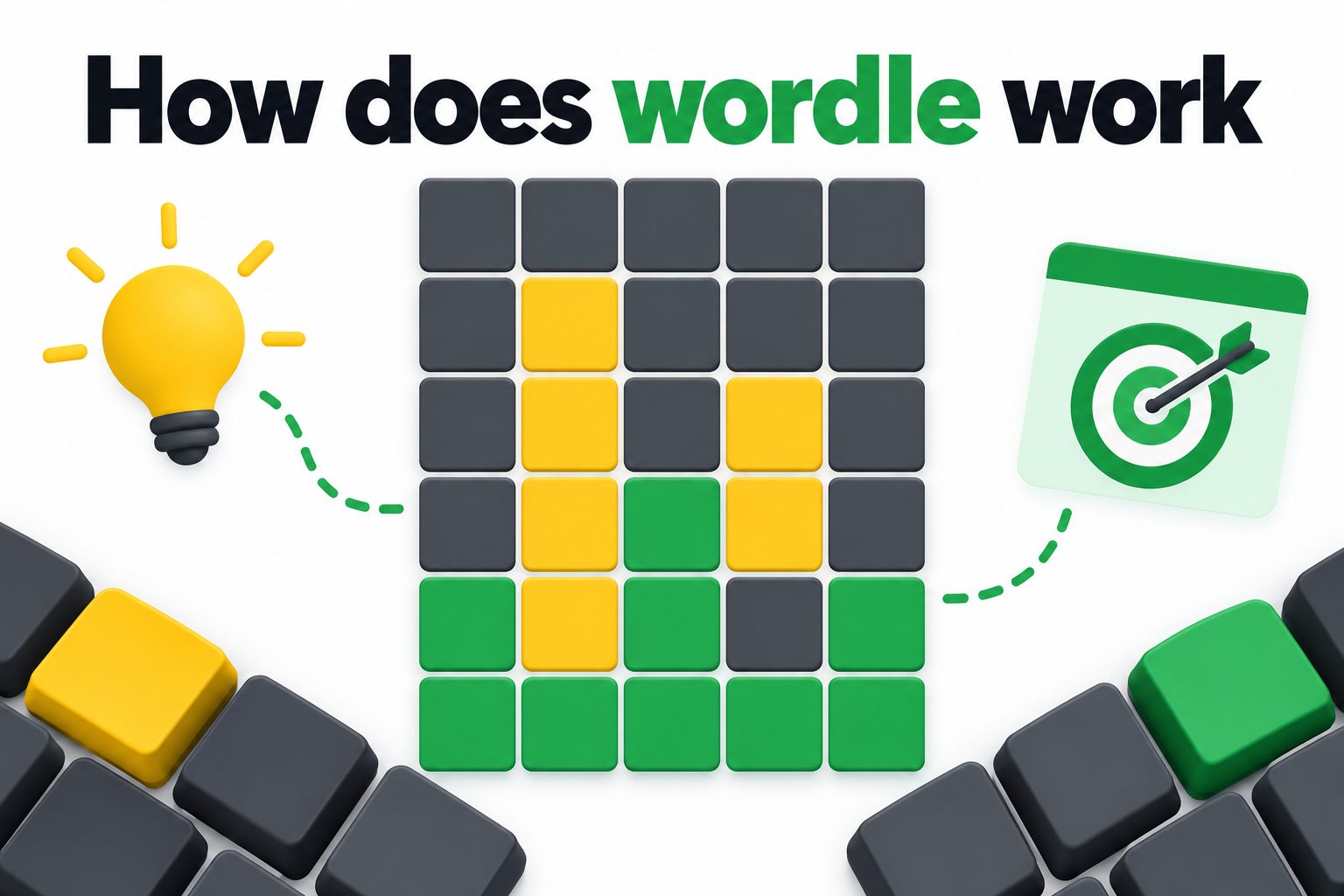
Wordle is a simple daily word puzzle in which you try to guess a hidden five-letter word within six attempts. After each guess, the game gives colored clues: green means a letter is correct and in the correct position, yellow means the letter appears in the answer but belongs somewhere else, and gray means the letter is not used in the answer. The rules are easy to learn, but solving the puzzle well requires vocabulary, deduction, careful letter placement, and a little patience. This guide explains how does wordle work, including the meaning of each color, the step-by-step process, useful strategies, common mistakes, examples, benefits, and practical tips for improving your results without relying on random guesses.
How Wordle Works
Wordle gives every player one hidden five-letter word to solve. You enter a valid five-letter word, submit it, and receive feedback based on how closely your guess matches the answer. The game does not tell you which word is correct immediately. Instead, it gradually reveals information so you can narrow down the possibilities.
You normally have six guesses. If you find the answer before using all six rows, you win. If all six guesses are used without finding the word, the answer is revealed. The daily format makes the game especially appealing because everyone receives the same puzzle on the same day.
The word is selected from an approved list. This means that some unusual words, names, abbreviations, and obscure spellings may not be accepted as guesses. The answer list is usually designed to contain familiar words, although some puzzles can still feel challenging because of repeated letters, uncommon letter patterns, or multiple possible meanings.
The Meaning Of Wordle Colors
Wordle’s colored tiles are the central part of the game. Each color provides a different type of evidence, and using that evidence correctly is more important than simply finding words quickly.
Green letters are in the correct position. If the first letter of your guess turns green, the answer begins with that letter. You should keep that letter fixed in the same position during later guesses unless you discover a special repeated-letter situation that changes how the feedback should be interpreted.
Yellow letters are present in the answer but positioned incorrectly. A yellow tile tells you to keep the letter in your thinking while moving it to another position. For example, if the letter A is yellow in the second position, A belongs somewhere in the word but cannot remain in that position.
Gray letters are not available in the answer, at least according to the game’s letter-count rules. Once you receive gray feedback, you can usually stop using that letter in future guesses. However, repeated letters require extra care because one copy may be accepted while another copy appears gray.
The order in which the colors are shown matters. Wordle checks both the letter and its position, then accounts for how many times each letter appears in the answer. This prevents players from assuming that every repeated letter in a guess must appear in the hidden word.
A Simple Wordle Example
Imagine that the hidden answer is BRICK and you guess CRANE. The C may turn yellow because it appears in BRICK but is in the wrong position. The R may also turn yellow because it belongs in the answer but is placed incorrectly. The A and N would turn gray because they are not in BRICK. The E would also be gray.
Your next guess should use the information rather than repeat the same arrangement. You might place C and R in different positions while testing useful new letters. The goal is not merely to guess another word. The goal is to create a guess that produces more useful information.
Suppose your next guess places C in the correct position and produces a green tile. That position is now confirmed. If R remains yellow, you know it must occupy one of the remaining spaces. Each result reduces the number of possible answers.
How To Play Wordle Step By Step
The following process helps new players approach each puzzle logically instead of relying entirely on instinct.
Choose a strong opening word. Begin with a valid five-letter word containing several common vowels and frequently used consonants. Words such as “crane,” “slate,” “trace,” or “arise” can reveal useful information, although no single starting word is guaranteed to be best.
Submit the guess and study every color. Do not focus only on green tiles. Yellow and gray tiles are also valuable because they tell you where letters may or may not belong.
Record confirmed letters mentally or on paper. Green letters should remain in their positions. Yellow letters should remain available but should be moved. Gray letters should normally be excluded from future guesses.
Choose a second word that tests new information. If your first guess contains several gray letters, avoid repeating them. If you discovered yellow letters, place them in different positions while introducing one or two new common letters.
Look for likely word patterns. English words often use combinations such as “ch,” “sh,” “tr,” “st,” “br,” “ing,” or “ound.” Recognizing these patterns can help you identify possible answers once several letters are known.
Check the number of letters carefully. If you suspect a repeated letter, test whether the answer can naturally contain it twice. A green or yellow result for one copy does not automatically guarantee that another copy is present.
Use the final guesses strategically. When only a few possibilities remain, choose between solving and testing. If you know the answer is probably one of two words, a guess that distinguishes between them may be more useful than immediately choosing one at random.
Why Wordle Is More Than A Guessing Game
Wordle looks like a vocabulary game, but its real appeal comes from combining language with logic. You are not simply trying to remember a word. You are interpreting evidence, managing uncertainty, and deciding which guess can provide the greatest advantage.
The game rewards flexible thinking. A player may begin with one possible word in mind, then need to abandon it when the colors contradict that idea. Good solving requires a willingness to revise assumptions instead of forcing every clue to fit an early guess.
Wordle also creates a satisfying balance between skill and luck. A familiar answer may be easy for one player and difficult for another, depending on vocabulary and previous experience. Even when the answer is unfamiliar, careful use of color clues can still lead to a successful solution.
The daily limit makes the puzzle feel manageable. Because there is usually one main puzzle per day, players can enjoy a short mental challenge without feeling pressured to spend hours playing. The limited format also gives each guess more importance.
Benefits Of Playing Wordle
Wordle can provide several practical mental benefits when played casually and thoughtfully.
<ul>
<li><strong>Vocabulary practice:</strong> The game exposes players to word patterns, spelling structures, and less familiar five-letter words.</li>
<li><strong>Logical reasoning:</strong> Each color clue requires players to compare possibilities and eliminate incorrect options.</li>
<li><strong>Pattern recognition:</strong> Repeated exposure helps players notice common combinations of vowels, consonants, prefixes, and endings.</li>
<li><strong>Memory support:</strong> Remembering which letters have been tested can strengthen short-term information management.</li>
<li><strong>Concentration:</strong> The limited number of attempts encourages focused attention on small details.</li>
<li><strong>Social connection:</strong> Sharing results without revealing the answer allows friends and families to compare experiences.</li>
</ul>
How Repeated Letters Work In Wordle
Repeated letters are one of the most confusing parts of Wordle. A word may contain the same letter twice, but the game does not always mark every copy in the same way.
Suppose the answer contains only one E, but your guess uses E twice. One E may turn green or yellow, while the other appears gray. This means the answer has already accounted for the available E. The gray tile does not necessarily mean that E is completely absent; it can mean that your guess used more copies than the answer contains.
If the answer contains two copies of a letter and your guess also uses two, both may receive colored feedback. Their colors depend on whether the positions are correct. This is why repeated letters should be analyzed together rather than separately.
When you suspect a repeated letter, consider the word’s structure. Double letters often occur in places such as the middle or ending of a word, but they can appear in many patterns. Do not assume that a letter must occur only once simply because the first clue did not reveal a second copy.
Common Wordle Mistakes To Avoid
Many unsuccessful guesses come from misunderstanding the clues rather than lacking vocabulary. Avoiding a few common habits can improve your solving process quickly.
1. Repeating Gray Letters
Using several gray letters again wastes a valuable attempt unless you are deliberately testing a repeated-letter possibility. Once a letter has been ruled out, remove it from your working list. This gives every new guess a better chance of revealing useful information.
2. Ignoring Yellow Letters
A yellow letter is not a failed letter. It belongs in the answer, but it must move. Players sometimes focus on green tiles and forget yellow ones, then submit guesses that place the same confirmed letter in the same incorrect position.
3. Keeping A Favorite Guess Too Long
It is easy to become attached to a possible answer after seeing a few matching letters. However, a single contradiction can eliminate it. Treat every guess as a hypothesis, not a commitment, and let the feedback guide you toward better options.
4. Testing Too Few New Letters
Some guesses rearrange known letters without checking anything new. That approach may help solve a nearly complete word, but early in the puzzle it can leave too many possibilities unresolved. Include useful untested letters whenever the situation allows.
5. Forgetting Word Validity
Not every combination of letters forms an accepted Wordle word. A guess may seem logical but fail because it is a name, abbreviation, plural form, or uncommon spelling. Use ordinary dictionary words unless you have a strong reason to test something unusual.
6. Panicking Near The End
Having one or two guesses left can create pressure, but rushing often leads to avoidable errors. Review every known green, yellow, and gray letter. Then compare the remaining possibilities carefully before committing to the final answer.
Best Practices For Better Wordle Results
Strong Wordle players do not necessarily know every answer. They make each guess work harder by balancing solving progress with information gathering.
1. Start With Balanced Words
A good opening word often combines common vowels and consonants. Testing several high-frequency letters gives you a clearer picture of the answer than beginning with a word containing repeated letters or rare characters.
2. Separate Confirmed And Possible Letters
Keep green letters fixed, move yellow letters, and remove gray letters. Thinking of these groups separately prevents confusion and makes it easier to visualize the remaining word patterns.
3. Avoid Unnecessary Repetition
Repeating a known letter can be useful when you are testing whether it appears twice. Otherwise, use new letters to gather more evidence. Early guesses should usually maximize discovery rather than focus on a narrow possibility.
4. Consider Letter Frequency
Common letters such as E, A, R, T, O, L, I, S, N, and C frequently appear in English words. Testing them can improve your odds, but frequency should support the clues rather than replace them.
5. Use Position Information
A yellow letter tells you both what is present and what is impossible. If a letter is yellow in the third position, eliminate that position immediately and examine the remaining spaces.
6. Think In Word Families
Once you have a pattern such as “_IGHT,” consider words that share the ending, including NIGHT, LIGHT, MIGHT, and SIGHT. Then use the unused letters and earlier clues to decide which candidate fits.
7. Review Before Submitting
Take a moment to check every tile implication. Confirm that your proposed word does not include gray letters, that yellow letters have moved, and that green letters remain fixed. This short review can prevent a careless loss.
Wordle Strategies For Different Situations
The best strategy changes depending on how much information you have already collected. Early guesses should explore the letter set, while later guesses should focus on narrowing a small group of candidates.
When the first guess produces mostly gray tiles, use a second word containing different common vowels and consonants. This gives you broad coverage and may reveal the basic shape of the answer.
When you receive several yellow tiles, prioritize rearrangement. Your next guess should place those letters in new positions while adding enough fresh letters to distinguish between possible word patterns.
When you find two or three green letters, concentrate on completing the structure. Think about common beginnings, endings, blends, and vowel arrangements. At this stage, introducing too many unrelated letters may be less helpful than testing a strong candidate.
When multiple answers remain possible, use a “check” word. This is a word chosen mainly to separate candidates. It may not be a likely answer itself, but its letters can reveal which possibility is correct.
When the answer appears to contain a repeated letter, pay attention to the feedback count. Repeated-letter puzzles are often solved by recognizing that a gray duplicate limits the number of copies in the hidden word.
Practical Wordle Use Cases
Although Wordle is primarily a game, it can be used in several enjoyable and educational settings.
1. Daily Mental Warm-Up
A short puzzle can serve as a morning mental exercise. It encourages focused attention and gives players a simple challenge before beginning other tasks.
2. Classroom Vocabulary Activity
Teachers can use Wordle-style puzzles to discuss spelling patterns, vowel placement, prefixes, suffixes, and word families. The color system makes abstract deduction visible and engaging.
3. Family Game Time
Because the puzzle is easy to explain, family members of different ages can solve it together. Players can discuss clues without necessarily revealing the answer, creating a cooperative experience.
4. Language Learning Practice
English learners can use the game to notice common letter combinations and expand their vocabulary. A dictionary can help explain unfamiliar words after the puzzle is complete.
5. Team-Building Exercise
Small groups can solve a shared puzzle while discussing possible guesses. The activity encourages communication, listening, and evidence-based decision-making.
6. Personal Progress Tracking
Players can review their results over time and notice whether they are improving at preserving guesses, recognizing patterns, or avoiding repeated mistakes.
Advanced Wordle Tips
Once the basic rules feel comfortable, a few advanced ideas can make your decisions more precise.
1. Value Information Over Immediate Success
A guess does not need to be the answer to be useful. Early in the game, a word that tests several untried letters may create more value than a narrow guess based on limited evidence.
2. Track Letter Positions Mentally
For each yellow letter, remember every position that has been ruled out. This prevents you from accidentally returning a letter to a location that the game has already rejected.
3. Watch For Vowel Patterns
Many five-letter words contain two vowels, while some contain one or none. Once you know which vowels are absent, think about consonant-heavy word structures rather than continuing to search for familiar vowel patterns.
4. Recognize Trap Groups
Words such as BIGHT, FIGHT, LIGHT, MIGHT, NIGHT, RIGHT, and SIGHT can create difficult choice groups. When several options share most letters, use a testing guess if you have enough attempts remaining.
5. Do Not Overvalue Rare Letters
A puzzle may contain J, Q, X, or Z, but guessing rare letters too early usually provides less benefit than testing common ones. Consider rare letters when the pattern or remaining possibilities makes them plausible.
6. Use Word Structure
English spelling follows recurring patterns. Endings such as “-er,” “-ed,” “-ing,” and “-ly” can suggest possibilities, although Wordle answers are limited to five letters. Blends and common consonant pairs can also guide your search.
7. Learn From Failed Games
After a loss, examine where the reasoning broke down. You may have ignored a yellow tile, repeated excluded letters, or chosen a word that revealed too little. Reviewing the process is more useful than simply memorizing the answer.
Frequently Asked Questions
1. How Many Guesses Do You Get In Wordle?
You usually receive six guesses to find the hidden five-letter answer. Each guess must be a valid word accepted by the game. If you solve the puzzle within those attempts, you win. If you use all six guesses without finding the answer, the game reveals the solution.
2. What Does Green Mean In Wordle?
A green tile means the letter is correct and appears in the correct position. Keep that letter in the same place during later guesses. Green letters are the strongest clues because they confirm both the identity of a letter and its exact location.
3. What Does Yellow Mean In Wordle?
A yellow tile means the letter appears somewhere in the answer but is placed incorrectly in your guess. You should use that letter again in another position. Yellow feedback also tells you that the original position cannot be correct, which helps narrow the word’s structure.
4. Can Wordle Have Repeated Letters?
Yes, Wordle answers can contain repeated letters. A word may include two copies of the same vowel or consonant. The game marks repeated letters according to how many copies appear in the answer, so one copy can be colored while another is gray.
5. Is There A Best Starting Word?
There is no universally perfect starting word because different strategies value different goals. Some players prefer words with common vowels, while others prioritize frequent consonants or broad letter coverage. The best opening word is one that helps you interpret clues consistently.
6. Does Wordle Test Vocabulary Or Logic?
Wordle tests both. Vocabulary helps you recognize possible answers and word patterns, while logic helps you use colors to eliminate impossible choices. A player with moderate vocabulary can still solve many puzzles by organizing clues carefully and avoiding guesses that provide little information.
Conclusion
Wordle works by combining a hidden five-letter answer with a six-guess limit and a simple color-feedback system. Green confirms a letter and its position, yellow confirms a letter but rejects its position, and gray normally removes a letter from consideration. Repeated letters require extra attention because the game accounts for the exact number of copies in the answer.
The most effective approach is to choose informative opening words, record every clue, move yellow letters, preserve green letters, avoid excluded letters, and use later guesses to separate remaining possibilities. With practice, Wordle becomes less about random guessing and more about vocabulary, pattern recognition, logical deduction, and careful decision-making.